
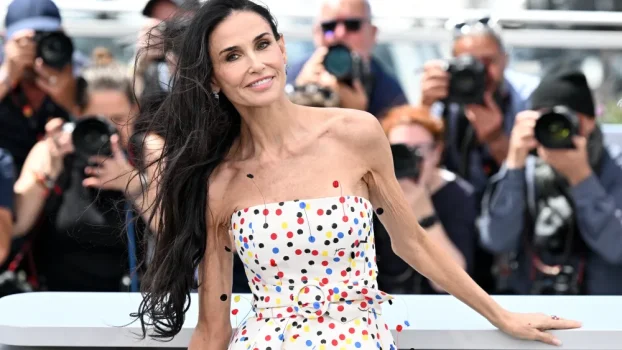
Demi Moore was blunt.
“AI is here,” Moore, a jury member at this year’s Cannes Film Festival, said during a press conference on Tuesday. “And so to fight it is to fight something that is a battle that we will lose. So to find ways in which we can work with it, I think, is a more valuable path to take.”
On social media, the reaction was swift and often vicious, with some commentators blaming Moore for selling out and others faulting her for failing to recognize the danger that AI poses to the creative community. But throughout the festival, there was abundant evidence that AI is not only here, it’s already reshaping how movies are produced.
At the Cannes market, there were several films that not only acknowledged their use of AI, but used it as a selling point. They include “Critterz,” an animated family film from Stuart Ford’s AGC Studio that bills itself as “human-led but AI-assisted,” as well as “Paradise Lost,” an adaptation of the John Milton poem from “Pulp Fiction” co-writer Roger Avery and “Bitcoin,” a thriller from “The Bourne Identity’s” Doug Liman, which features Gal Gadot, Casey Affleck and Pete Davidson. “Bitcoin” is being produced by Ryan Kavanaugh, the controversial Relativity Media founder, who is working the Croisette as he drums up interest in his new venture, Acme AI & FX, which promises to help filmmakers with “AI-assisted workflows” and “real-time image development.”
“A year ago, some people were using AI, but they were embarrassed to admit it,” says one veteran sales agent. “This year, they aren’t even hiding it.”
The reaction has been dramatically different than in past editions of Cannes, Sundance or other major film festivals, where AI was typically positioned as an agent of destruction. There are still fears that AI will replace actors in films (Tilly Norwood, anyone?) and it’s a virtual certainty that it will lead to fewer jobs in everything from animation to visual effects to script readers (those cuts are already happening). But there seems to be a growing sense that the best course of action is to find a way to protect copyrighted material and ensure that actors are compensated for their likenesses and voices being used by tech companies. Matthew McConaughey, for instance, had his legal team file for eight trademarks, which the U.S. Patent and Trademark Office granted in 2025.
“My team and I want to know that when my voice or likeness is ever used, it’s because I approved and signed off on it,” McConaughey said in a statement. “We want to create a clear perimeter around ownership with consent and attribution the norm in an AI world.”
At one industry event after another, executives, producers and creative talent amplified Moore’s message: Resistance is futile. Many saw AI as a chance to help them get movies on the screen that might have been deemed too costly or risky.
“As a producer, I look at as a tool like any other tool,” Laura Lewis, CEO and founder of Rebelle Media, said on a panel about the U.S. film business on Friday. “If it creates efficiencies, if it allows us to get something made that we couldn’t make because you can’t get the budget down, that’s helpful.”
On the same panel, Kent Sanderson, the head of Bleecker Street, argued that AI won’t just lower the cost of producing movies; it will allow users to challenge major studios at their own game.
“You can’t avoid the fact that it is going to be a part of our business,” Sanderson said, adding, “It is going to lower production costs, and yes, you probably will be able to make something that looks like a Marvel movie in your basement in a couple of years.”
But Sanderson thought that the ubiquity of loud, dumb, spectacle-driven entertainment of the type that has dominated Hollywood slates may lead to a creative revolution.
“That also means there’s that people might be looking for something else,” Sanderson argued. “Because if something is so incredibly common and so available, people tend to go in the other direction and look for something new. So for me, that might be a hidden opportunity for real cinema.”
Not everyone is as sanguine about the potential that something positive will emerge from the technological disruption. In his opening press conference, Cannes Film Festival director Thierry Frémaux sounded a note of caution about a future shaped by computational systems.
“We have to be on our guard, but at the same time understand it a bit,” Frémaux said, adding, “What I can say with certainty in relation to artificial intelligence is that we are on the side of the artists, the screenwriters, actors and voice actors. We stand with everyone whose job could be negatively impacted by artificial intelligence. It requires legislation. We need to control this.”




Add comment