
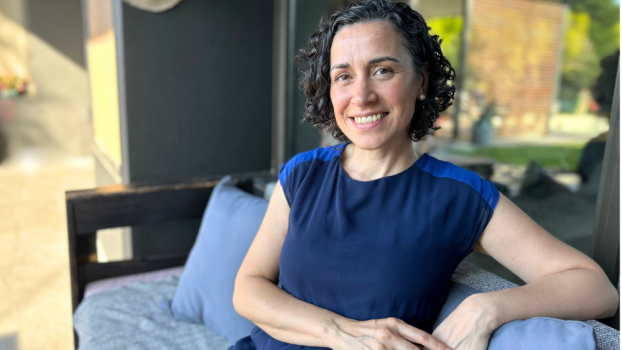
Silvina Cornillón arrives at this year’s Quirino Awards, its 9th edition taking place over April 15-17, in a different position than 12 months ago. No longer stepping into the role mid-cycle, the director now has a full year behind her and a clearer view of both the event and the industry it serves.
“There has been a lot of movement, and there still is,” Cornillón told Variety. “Now I have a deeper understanding of how everything connects: the institutions, the professionals, the challenges.”
While the event has grown steadily since its launch, Cornillón is careful about how that growth is defined. “We need to grow, but in a nice way,” she said, pointing to a focus on maintaining quality while “maximising the opportunities we are giving to the producers coming.”
Behind that approach is a difficult reality, producers across Ibero-America are facing tighter financing conditions and a more uncertain market, forcing them to rethink how projects are made, funded and brought to audiences. “I think some producers are sometimes lacking information about how these new models are working,” Cornillón explained, referencing shifts in distribution and financing that will be explored at this year’s Futures Lab. “If there is a group of professionals that can adjust quickly, it’s those coming from Latin America and Ibero-America.”
That adaptability, she suggests, is rooted in experience. In parts of Latin America, producers are used to working in environments where institutional support can fluctuate with each political shift, requiring faster responses to change. “The reliability on public institutions giving funds… sometimes can be really low,” she said. “Co-productions and working collectively — that has always been the answer. Now it’s more than ever.”
For Quirino, that is feeding directly into how the event is structured. This year’s edition expands the Co-Production Forum, adding an additional day of meetings. “It was necessary to give more space to the business part of our event,” Cornillón said. “It’s also a way of showing the respect we have for the investment people are making to come.”

Cornillón with Quirino attendees at the Women in Animation panel 2025
At the same time, the event has moved back to Santa Cruz, returning to its original base after a period in La Laguna. While the previous location offered logistical ease in the smaller La Laguna, the Quirino team believe Santa Cruz opens up new possibilities and reconnects the event more directly with the local industry it has helped shape. Some of the Canary Islands’ premier animation studios are based there including Atlantis, 3Doubles, Red, and B-water among others.
“When Quirino started, it was part of a plan to build an industry in Tenerife,” Cornillon said. “Now, eight years later, you can see how effective that was. There are many studios now — companies that have grown a lot, and others that came because of Quirino.”
That relationship is also informing smaller changes, including a stronger focus on local engagement. This year, all nominated short films will be screened for local audiences, accompanied by video introductions from their directors. Cornillón sees it as part of a broader effort to connect the event with emerging talent and to inspire local people to pursue working in the industry.
Internationally, Quirino is also adjusting its focus. This year’s nominees announcement was held in São Paulo, part of a wider push to deepen ties with Brazil. The country has long been present in the awards, but Cornillón believes its full potential within the Ibero-American animation landscape has yet to be realised.
“It was a big challenge,” she said of the move. “But it already paid off, we are having a bigger delegation from Brazil this year and a deeper understanding of the Brazilian industry, thanks for the special session we held of Quirino Futures Lab.”
It reflects a wider recalibration in how Quirino approaches its global network. Rather than simply attracting high-profile companies, Cornillón wants the emphasis to be on bringing in partners who are actively looking to collaborate. “If you say, ‘I had a meeting with someone from a big platform,’ that sounds amazing,” she said. “But are they really planning to invest in your project? It’s about being realistic, not thinking that someone will come and save you.”
That pragmatism extends to how event defines itself. Despite the visibility of its awards ceremony, Cornillón is keen to move beyond that singular identity. “The continuing challenge is to get people to understand that it’s not only about one single thing,” she said. Alongside the awards, the Co-Production Forum, Futures Lab and Quirino Lab now form a wider framework that operates throughout the year. “We realized our ecosystem had grown beyond what our communication was capturing.”
The ambition is to turn Quirino into a something as consistent and reliable for the sector it serves as they can. “In a moment where it’s harder to trust institutions, we want to be something you can trust,” she described. “We want to be there, to facilitate, to help make things happen.”
For an industry navigating tighter financing, new models and constant change, that role may prove as important as the awards themselves.







Add comment