
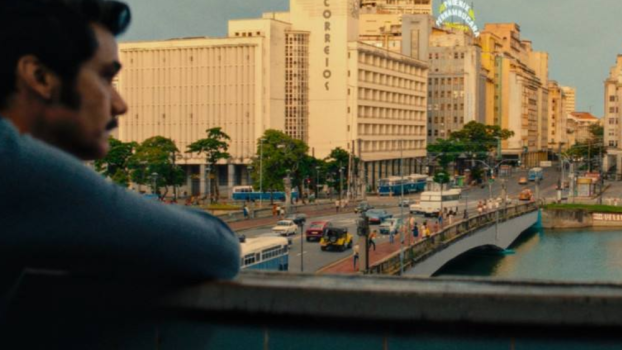
Almost exactly a year ago, Kleber Mendonça Filho, Wagner Moura and the large cast and crew behind “The Secret Agent” turned the famed Cannes Film Festival red carpet into an impromptu carnaval parade courtesy of renowned Pernambuco frevo group Guerreiros do Passo. That homage to the rich culture of Pernambuco mirrored the four-time Oscar-nominated film’s ode to the state capital of Recife, which, thanks to Mendonça Filho and other major exponents such as Gabriel Mascaro and Marcelo Gomes, plus a talented — and hungry — new generation, has solidified itself as a hotpot of film talent in Brazil.
Speaking at the opening of the Projeto Paradiso Talent Network National Meeting, held this year in Recife, the Secretary of Culture of Pernambuco, Cacau de Paula, said the state of Pernambuco is a “direct part” of Brazil’s historical film momentum over the last two years. “Our cinema is over a century old and so rich. We had a historical year with ‘The Blue Trail’ and ‘The Secret Agent,’ it’s a great moment from cinema from Pernambuco and a great opportunity to share our landscapes, our creativity, our people, our way of speaking with the world.”
At the end of March, Recife held the National Meeting for Regional Audiovisual Incentives, organized by Brazil’s national setorial fund (FSA). Key industry figures from across the country gathered at the imposing São Luiz Cinema, which can be seen at length in “The Secret Agent,” to sign 41 terms of cooperation between federal, state and local governments. Pernambuco was granted R$24,6 million ($5 milion), with R$20 million ($4 million) coming from the federal government through the FSA and the remainder from the state through Adepe.

Projeto Paradiso Talent Network National Meeting 2026, courtesy of Juana Carvalho
“We from the government of Pernambuco are immensely proud of our cinema and renewed public incentive policies,” she added. “We are witnessing a rich period following the Paulo Gustavo Law, regional incentives, and with more to come soon. Culture Minister Margareth Menezes was [in Recife] recently to launch regional incentives, a key initiative during such a rich moment for Brazilian cinema, where we are successfully uniting creativity and public support to generate new opportunities. To see all of you here is to see the future we want for our cinema. We are seeing the cinema of tomorrow, respecting our past and our traditions.”
Cinema from Pernambuco, and Recife specifically, has a long, century-old tradition. In the 1920s, the Recife Cycle (Ciclo do Recife) was a pioneering movement in silent cinema and one of the most productive crops of the century in the country, producing 13 features in 8 years. Towards the end of the ’90s the early 2000s, Recife housed another crucial film movement, with seminal films such as Lírio Ferreira and Paulo Caldas’s “Perfumed Ball” (1996), Marcelo Gomes’s “Cinema, Aspirins and Vultures” (2005) and Marcelo Gomes and Karim Aïnouz’s “I Travel Because I Have to, I Come Back Because I Love You” (2009).
The next generation was already impacted by the introduction of regional film funds towards the end of 2007. Between 2007 and 2011, cinema from Pernambuco saw investment increase by more than 500%, rising from R$2,1 million ($450,000) to R$11,5 million ($2.3 million), which tripled the number of local producers. Films released right after this jump include Mendonça Filho’s fiction feature debut “Neighboring Sounds” and Gabriel Mascaro’s “August Winds.”
Now, Mascaro and Mendonça, just off the back of major international successes with “The Secret Agent” and “The Blue Trail,” are in their very own moment of passing the torch to the next generation of filmmakers.
Courtesy of Guillermo Garza/Desvia
“Kleber’s arrival at the Oscars, as well as Gabriel’s trajectory over the last year, are very good thermometers of how the international market perceives our output, and it helps boost other local filmmakers,” says producer Thaís Vidal, of Filmes do Atlântico. Vidal is currently in post-production on “Paraíso de Mujeres,” by Argentinian director Karina Flomenbaum in co-production with Nevada Cine, and financing for “Amazon Dream,” by Andrew Sala. She’s also working on her directorial debut, “Absence Sensor,” a Brazil-France co-production with Socle, Vitrine Filmes, Moçambique and Filmes do Atlântico.
Legendary Recife producer João Vieira Jr. of Carnaval Filmes tells Variety that his home city is “bearing the fruits of decades of collective work.” “We were a generation that decided, at the end of the ’90s, that it was possible to make quality cinema in Recife without asking for permission from the Rio-São Paulo axis. ‘Perfumed Ball’ opened that door, then ‘Cinema, Aspirins and Vultures’ went to Cannes and ‘I Travel Because I Have to, I Come Back Because I Love You’ went to Venice.”
“Each of these steps proved that cinema from Pernambuco is not a regional phenomenon; it is a cinema with its own language that can be in dialogue with the world. What we are experiencing today is the consolidation of a work that has been conducted for a long time,” adds Vieira Jr., who is currently in post-production with “Correnteza” (“River Flow”) written by Wislan Esmeraldo, screenwriter of “Motel Destino,” and Hilton Lacerda (“Tattoo”), and about to wrap shooting for “Madrugada,” by Armando Praça (“Greta”), which was shot entirely at night in the Recife city centre.
When talking to local filmmakers, one unanimous sentiment is pride over the sense of community built by the industry in Recife. At the beginning of the century, the sense of isolation from the industry hub of the Southeast, plus the lack of structured funding opportunities, led producers, directors and writers to band together to get films made. Two decades later, the Bolsonaro government, followed by the pandemic, replicated this need for a strong union to a younger generation.
“We had collectives and, with them, possibilities of working on each other’s films, wearing different hats, exchanging feedback… At that time, scarcity acted as a driving force for collaboration,” says Emilie Lesclaux, the French producer based in Recife who landed a historic best picture Oscar nomination for “The Secret Agent” earlier this year.
“When I shot my first feature 22 years ago, we did not have a film school,” echoes veteran Marcelo Gomes. “Only two or three feature films had been made in Recife in a period of 30 years. So we brought in heads of departments from other states, but we made a point of taking in several interns and paying it forward. Several people who worked on our sets went on to make films of their own, like Gabriel Mascaro, Juliano Dornelles and Pedro Sotero.”
“Cinema, Aspirins and Vultures”
“Pernambuco was the first state in Brazil to open a public call for projects, and that was only because we were very united as artists and we pressured the government,” he emphasizes. “This allowed us to build a very tight creative network, built upon a sense of solidarity. In Rio, things are very fragmented; the city is much bigger.”
Mendonca Filho says something similar, remarking that when he was making “Neighboring Sounds” he was “pressured to hire a big name as a cinematographer” but chose newcomer and friend Pedro Sotero. “Today, he is one of the great Brazilian cinematographers. These decisions are technical, but also affectionate.”
The Golden Globe-winning filmmaker remarks how, just last week, five creatives from Pernambuco were awarded Platino Awards for their work in “The Secret Agent”: Tomaz Alves Souza and Mateus Alves for original score, Thales Junqueira for production design and Eduardo Serrano and Matheus Faria for editing. “It only reiterates the notion that you can make great cinema in Recife. It’s crazy that it would even be up for discussion in 2026.”
Writer-director Karkará Tunga, who is currently working on his directorial feature debut “Batoki: Noite Sem Lua,” recalls being part of the inaugural class of graduates from Recife’s first film school, another watershed moment for the city’s film community. “When I arrived in Pernambuco and saw the level of public funding available, I understood it was possible to make films here,” points out the creative, whose family is from Pernambuco but was raised in São Paulo, a reality faced by many second-generation filmmakers born in families who’ve left the Northeast for the Southeast in the ’80s and ’90s.
“We are still a way to go when it comes to Indigenous and Black filmmakers accessing these resources, but there is a sense of possibility,” adds Tunga. “I was part of the first class of students to graduate from the local film school, and I could see a much more diverse group of filmmakers coming right after me. The film school generation challenged this hegemony to create a strong sense of community and nurture the desire to build a new cinema. One that feels much more concrete today than six years ago, when the Bolsonaro government decimated our public structures.”
Despite all the many positives, like everywhere else in the world, there are still challenges plaguing the local industry. “Our disadvantages are structural,” says Vieira Jr. “We are far away from the financing hubs, lack quality screening rooms away from the capital cities, and heavily depend on federal financing open calls directly tied to the unsteady rhythms of Brazil’s cultural policies. We’ve learnt to be resilient, but we deserve more, and we know how to ask for it.”
“I also hope we as artists continue to pressure the government to promote cinema and to cultivate audiences,” echoes Gomes. “We need fresh audiences, we need films made in Recife to be seen across Brazil.”
Producer Wandryu Figueredo do Nascimento, who is currently working on “Ontem Foi Dia 22 de Junho,” points out that Recife needs more training centers and development opportunities. “Our neighboring state of Ceará has incredible labs, workshops, and established training programs for writers,” continues the producer. “We only have the film school and film festivals to rely on. The Ceará Film Commission is also way ahead of our newly inaugurated Recife Film Commission, but we are hopeful it’ll get there.”
“For something like [‘The Secret Agent’] to happen again, we need a local policy to build bridges between local production companies and the international market, promoting the participation of Pernambuco producers at big co-production platforms,” remarks Vieira Jr. “It is not enough to make extraordinary films, we need producers to have a seat at tables where decisions are made.”







Add comment