
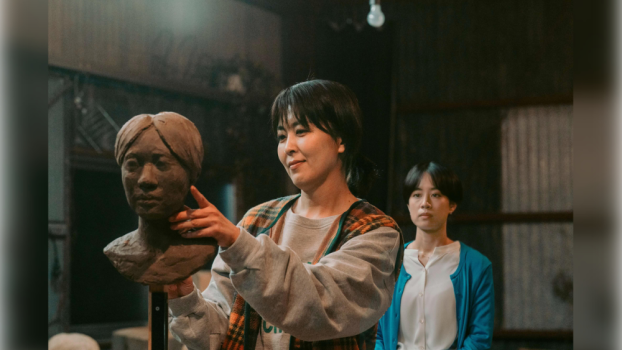
No voices are raised in “Nagi Notes,” in the course of a tranquil week or so spent in a remote rural village in western Japan. No seismic incidents disrupt the film’s mellow day-to-day flow, and though we hear sporadic background rumbles from a military base in the area, no urgent mortal threat hangs over proceedings. But the calm is deceptive. Conflict courses through Koji Fukada‘s subtly stirring new film to increasingly urgent, disquieting effect, raising the human stakes of polite everyday exchanges and encounters: If lives don’t literally hang in the balance, the meaning and quality and value of life does. For two women, and two children, figuring out what they need to be happy, the difference between words said and unsaid is very consequential indeed, whatever the tone of voice.
The gentleness of “Nagi Notes” comes as no surprise from Fukada, a humane classicist whose work is marked by hushed restraint even when it trades in larger-scale drama. Occasionally, the delicacy of his filmmaking can tilt into wanness, which has been the case in his last few features: “A Girl Missing” and “Love Life” were both tasteful, well-acted but insipid melodramas, and while last year’s “Love on Trial” promised a swerve with its glossy J-pop milieu, it felt similarly underpowered.
“Nagi Notes,” however, happily sees the director returning to the form of his 2016 breakout “Harmonium,” with the precision of its characterization and the balance between heartfelt emotional candor and pensive silence in its finely worked script. It may be too muted for some arthouse distributors, but a Cannes Competition berth — the first of Fukada’s career — should help its prospects.
Patience tends to be a virtue with Fukada’s cinema, and it’s certainly required upfront, as the film takes its time in unraveling key connections between characters, while the nature of certain relationships must be surmised through cues of expression and body language. It opens on a skittish encounter between independent-minded Tokyo architect Yuri (Shizuka Ishibashi) and diffident teenage boy Keita (Kiyora Fujiwara) when the former arrives by train in the sleepy settlement in Nagi; it emerges that he’s been sent to pick her up by his art teacher Yoriko (Takako Matsu), with only a pencil sketch by which to recognize her. Not for the last time in this story, a character is considered through another’s artistic interpretation.
Yuri and Yoriko, it turns out, are former sisters-in-law, once close but estranged since Yuri divorced Yoriko’s brother. Yoriko, an accomplished sculptor, has invited Yuri to visit, and to sit for a sculpture — an unorthodox reunion in a patriarchal society where women’s social lives tend to be defined by the men who bind them. But Yuri and Yoriko have plenty in common besides, from artistic sensibilities to a shared emotional unrest: For Yoriko, Nagi is a bucolic balm for a heart broken long ago, and she intends for their surroundings to work a similar healing magic on her cosmopolitan Tokyo friend.
Attractive local widower Yoshihiro (Ken’ichi Matsuyama) nurtures a seemingly complementary loneliness, but “Nagi Notes” resists unfolding in quite the way one might expect: Solitude and sisterhood aren’t secondary narrative priorities here, as its characters pursue personal fulfillment and solidarity outside the domain of men. Both leads are wonderfully understated as they watch and mirror each other from scene to scene, each seeing in the other a type of freedom they don’t yet recognize in themselves.
If there’s an ambiguously romantic subtext to the women’s renegotiated friendship — if they don’t necessarily desire each other, they desire they lives they can live in each other’s company — a more explicitly queer love is explored between Yoriko’s two young art students: shy, vulnerable Keita and the more outgoing, assured Haruki (Waku Kawaguchi), who recognize in each other the kind of masculinity that’s otherwise little in evidence in Nagi, a society built around agricultural and military activity, and traditional family structures. In one exquisite scene between the boys, feelings are confessed as they peer through the viewfinder of a camera obscura, the world briefly upside down in line with their own shared, off-kilter sense of not belonging.
“Nagi Notes” risks obviousness at such points, but it can afford to do so. Amid the early-spring lightness of the filmmaking, Fukada values softly plainspoken earnestness of emotion, as his repressed, recessive characters learn to listen to their own impulses in the general stillness that surrounds them. Hidetoshi Shinomiya’s cinematography doesn’t overly prettify the stark rural landscape, still yellowed and freeze-dried from the winter but with a hopeful pastel crispness to the light: We see how Nagi can be a sanctuary or a prison to misfit souls at different stages of life. “I’m alone but not isolated,” says Yoriko, explaining how she finds kindship in her surroundings, her models, or even the wood she shapes to her imagination, and encouraging Yuri to do the same. Fukada’s modest, searching film suggests we could do worse than to seek a measure of aloneness, together.







Add comment